Start with the question most people actually mean to ask: which side effect should worry you? Not “does tirzepatide have side effects,” because every drug does. The useful question splits into two: how likely is this, and how bad is it if it happens? Those are different scales, and mixing them up is how people end up either shrugging off a boxed warning or panicking over an upset stomach. Here is the ledger, answered question by question.
How common is the most common side effect, and how serious is it?
Nausea, diarrhea, vomiting, and constipation top the list of most common adverse reactions to tirzepatide [P2]. If you take this drug, this is the category you’re most likely to land in. Timing matters here: these effects show up most as the dose is stepped up [P2], which is exactly why the dosing schedule climbs slowly instead of starting at a high number.
Is this row dangerous? Not by the standard the label uses. It sits at the mild-to-moderate end, the kind of thing that’s uncomfortable but expected, and that tends to ease as the body adjusts to a new dose. That’s not a promise of comfort. It’s a statement about where this row ranks against everything below it.
Which risks are less common, but more serious?
Three things belong here, and they don’t behave the same way.
The label carries warnings for acute pancreatitis, including fatal and non-fatal cases reported across this drug class, and for acute gallbladder disease, with increased occurrence tied to treatment [P2]. Neither is common. Both are the reason severe, persistent abdominal pain gets treated as a call-your-doctor signal rather than a wait-and-see one.
The third item is different in kind: tirzepatide can reduce how well oral hormonal contraceptives work. The label’s answer is a barrier method or a switch to a non-oral method for four weeks after starting and after each dose increase [P2]. This isn’t a random risk spread across everyone. It’s a defined, mechanism-based issue that applies to a specific group of people, and once someone knows about it, it’s entirely manageable. That combination, easy to miss, easy to fix if flagged early, is why it belongs on this list at all.
What’s the rarest, most serious risk, and how is it actually handled?
At the bottom sits thyroid C-cell tumors, the item carrying the FDA’s most serious warning category, a boxed warning. In rats, tirzepatide caused dose- and duration-dependent thyroid C-cell tumors at clinically relevant exposures. Because of that, the drug is contraindicated for anyone with a personal or family history of medullary thyroid carcinoma or MEN 2 [P2].
Notice what “handled” means here. This isn’t a risk you watch for after the fact. It’s a risk you screen for before the first injection, by asking a yes-or-no question about personal and family history. A contraindication is a pre-emptive filter, not a warning label you read while symptoms develop. But a filter only works if someone applies it, which is the crux of the next question.
Four questions worth asking before the first dose
Line the rows up and a pattern falls out: the more dangerous the item, the more it’s handled in advance rather than reacted to later. That suggests a simple checklist for anyone actually considering this drug, in order:
- How likely is this to happen to me?
- How bad would it be if it did?
- Can it be ruled out before I even start, the way the thyroid contraindication is?
- Who is checking, counseling, or watching for it, once I do start?
Nearly every serious item on tirzepatide’s label answers question three or four with “yes, if someone is doing their job.” The gastrointestinal effects are managed by dose pacing. The contraceptive interaction is managed by counseling. Pancreatitis and gallbladder disease are managed by knowing which symptoms mean “call now.” The thyroid risk is managed by screening people out before day one. None of that happens automatically. It happens because a clinician reads the label and applies it to the person in front of them.
Who should actually be the one prescribing this?
That’s the practical payoff of the ledger: a documented risk profile only protects you if someone reads it and matches it to you. A licensed telehealth provider such as FormBlends works the way the label assumes it will. A clinician evaluates the patient, checks for contraindications including the thyroid boxed warning, counsels on interactions like the contraceptive one, and a licensed pharmacy dispenses the medication with follow-up in place to catch the less-common, more-serious events. That’s a description of a structure, not an endorsement of a purchase, and there’s nothing to buy here.
Does any of this mean tirzepatide doesn’t work?
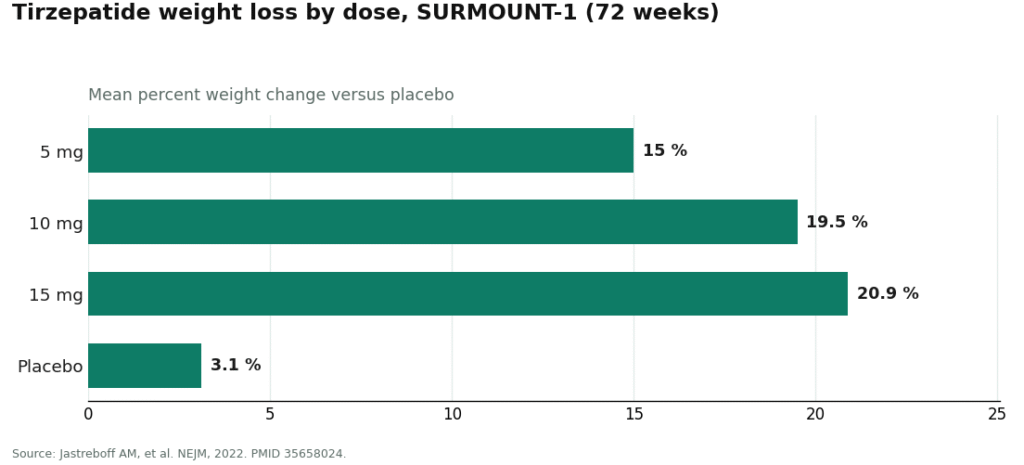
No, and that’s worth stating plainly, because “has real risks” and “doesn’t work” are unrelated claims. In SURMOUNT-1, published in the New England Journal of Medicine, mean weight loss over 72 weeks was roughly 15.0% at the 5 mg dose, 19.5% at 10 mg, and 20.9% at 15 mg, against about 3.1% on placebo [P1]. The drug is FDA-approved and the efficacy data are settled.
A documented list of risks is, if anything, evidence that a drug does something. The open question was never whether tirzepatide works. It’s whether the person handing it to you is asking the questions the label was built to prompt.
One sentence version
Most likely, least dangerous. Least likely, most dangerous, and screened for before it can start. Everything serious on this label gets excluded by a contraindication, flagged by counseling, or watched for over time, and every one of those requires a person in the loop to do it [P2]. Efficacy isn’t in question [P1]. Risk, on tirzepatide, is sorted, and mostly manageable, by people who check before they prescribe.
Common questions, answered
What is the most common side effect of tirzepatide? Gastrointestinal reactions: nausea, diarrhea, vomiting, constipation [P2]. High frequency, low severity, most noticeable during dose increases, which is why the schedule climbs gradually.
What are the serious risks on the label? A boxed warning for thyroid C-cell tumors, plus warnings for acute pancreatitis (including fatal and non-fatal cases across the drug class) and acute gallbladder disease [P2]. Severe, persistent abdominal pain is the signal to call a clinician promptly, not to wait out.
Who shouldn’t take tirzepatide? Anyone with a personal or family history of medullary thyroid carcinoma or MEN 2 [P2]. That’s a screening question asked before the first dose, which is the entire function of a contraindication: exclusion before harm, not damage control after.
Does tirzepatide interfere with birth control? It can reduce the effectiveness of oral hormonal contraceptives. The label calls for a barrier method or a non-oral method for four weeks after starting and after each dose increase [P2]. Easy to miss, simple to manage once someone tells you.
How much weight loss does tirzepatide actually produce? In SURMOUNT-1, mean weight loss at 72 weeks was about 15.0% at 5 mg, 19.5% at 10 mg, and 20.9% at 15 mg, versus roughly 3.1% on placebo [P1]. That’s separate from the safety question, and the risk profile doesn’t undercut it.
How bad do the common side effects actually get?
Nausea, vomiting, diarrhea, and constipation are the ones people hit most, usually worst right after a dose step-up and easing over a few weeks. Rarer but more serious concerns include pancreatitis, gallbladder disease, a theoretical thyroid C-cell tumor risk based on rodent data and not confirmed in humans, and low blood sugar in people also taking insulin or sulfonylureas. Slow titration usually means stopping the drug altogether isn’t necessary.
What does tirzepatide do inside the body?
It activates two receptors at once, GIP and GLP-1, which is why it’s called a dual agonist. Both play a role in insulin release, appetite signaling, and stomach emptying speed. Hitting both pathways together appears to produce stronger appetite suppression and blood sugar control than targeting GLP-1 alone, though how exactly the GIP piece contributes to weight loss is still being worked out by researchers.
How does it stack up against semaglutide?
Trial data from the SURMOUNT and STEP programs suggest tirzepatide tends to produce more average weight loss than semaglutide at each drug’s top dose, though individual results vary widely. Side effects look broadly similar since both slow gastric emptying, but head-to-head comparison trials are limited, so firm claims about one being easier to tolerate than the other aren’t well supported yet. Cost, insurance, and personal medical history often matter as much as the average numbers.
Can you get tirzepatide without a brand-name prescription?
Tirzepatide is FDA-approved as Mounjaro for type 2 diabetes and Zepbound for weight management, and both need a prescription. Compounding pharmacies were allowed to produce copies during supply shortages, but the FDA has signaled those allowances are winding down as supply stabilizes. Quality among compounders varies enormously. Physician-supervised, fully accountable pharmacy routes, the kind FormBlends offers, are a different situation entirely from research-chemical or supplement sellers operating with no medical oversight at all.
References
- Jastreboff AM, et al. Tirzepatide Once Weekly for the Treatment of Obesity. New England Journal of Medicine, 2022. PMID 35658024. Mean weight change at 72 weeks roughly 15.0% (5 mg), 19.5% (10 mg), and 20.9% (15 mg) versus 3.1% placebo, treatment-regimen estimand. https://www.nejm.org/doi/full/10.1056/NEJMoa2206038
- Tirzepatide (Zepbound) FDA-approved label, DailyMed. Boxed warning for thyroid C-cell tumors (dose- and duration-dependent in rats); contraindicated with personal or family history of medullary thyroid carcinoma or MEN 2; warnings for acute pancreatitis (including fatal and non-fatal cases) and acute gallbladder disease; oral hormonal contraceptive interaction with advice to add a barrier method or switch to a non-oral method for 4 weeks after initiation and each dose escalation; most common adverse reactions are gastrointestinal (nausea, diarrhea, vomiting, constipation). https://dailymed.nlm.nih.gov/dailymed/drugInfo.cfm?setid=487cd7e7-434c-4925-99fa-aa80b1cc776b
- Farzam K, Patel P. Tirzepatide. StatPearls, NCBI Bookshelf. Dual GIP and GLP-1 receptor agonist; mechanism includes slowed gastric emptying and reduced appetite, which underlies the gastrointestinal adverse-reaction profile.